the third person limited point of view focuses on
Third person limited is a tale point of view where the story is told from the close-hauled perspective of one character. It still primarily utilizes he, she, and they pronouns, merely creates the immediacy and affaire of a first-somebody narrative without being "trapped wrong" a protagonist's head.
In Steering the Craftiness, Ursula Le Guin's invaluable writing manual, she provides a succinct definition of this constricted viewpoint:
Only what the viewpoint character knows, feels, perceives, thinks, guesses, hopes, remembers, etc., force out Be told. The reader potty generalise what former people feel and think only from what the standpoin part observes of their behaviour.
In this section of our guide to literary points of view, we'll break down what it means to write from a constricted linear perspective. We'll likewise bid a few pointers to get the most taboo of this 'best of both worlds' point of view.
The unlimited potential of fractional person limited
Fractional person incomprehensive narrators are more common in contemporary fiction than their omniscient counterparts. There are unique qualities they work to their stories, ones that lay down this viewpoint perenially favourite with authors and readers alike.
Create greater intimacy with your reader
Third person limited offers access to a character's privileged thoughts and emotions, very much the unvarying way that kickoff-person narration does. American Samoa a result, it creates a sensation of 'narrative empathy,' making it easier for readers to suppose themselves in the viewpoint character's shoes — or as their confidante.
Example: Ender's Gamy by Orson Scott Card
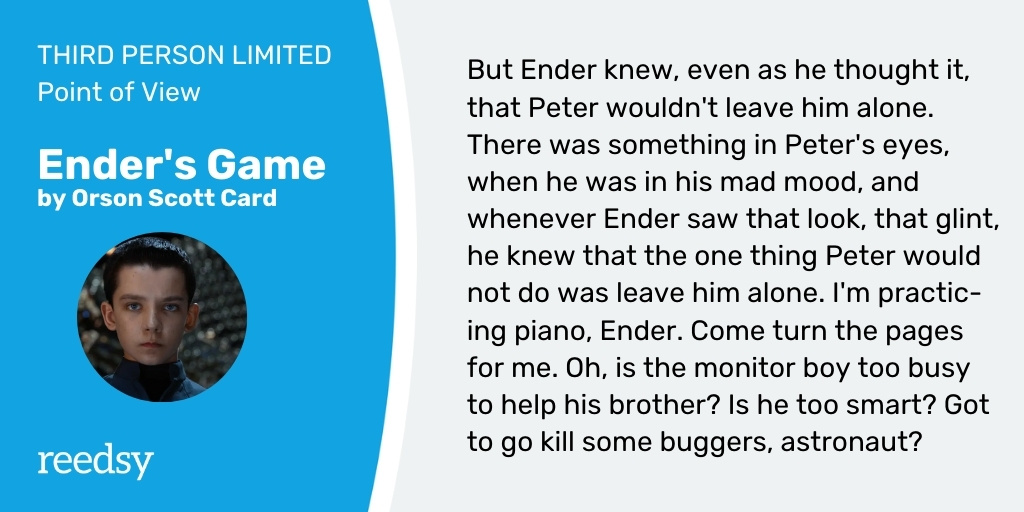
In this example from Orson Scott Lineup's Ender's Game, we are conferred a peek into our protagonist's thoughts. From his deductions of another's demeanour ("Simply Ender knew [...] that Peter wouldn't leave alone him alone") to scenarios where Ender imagines he's being harassed by St. Peter the Apostl, we're precise there in our protagonist's manoeuver.
When handled fit, you could fence that third person limited is even more friendly than a first individual narrative. Instead of a champion telling you their level, you are — in some right smart — encouraged to experience the story as the booster. Powerful stuff!
Pressure your readers to engage with the story
Returning to LeGuin's quote — "[t]He reader butt infer what other people feel and think only from what the point of view character observes of their behaviour" — we see a big reason wherefore this narrative mode is so fashionable. Because the modest narrator seat only discover what the viewport case observes, the reader oftentimes has to act detective. They have to take these observed details and connect the dots to understand what is happening.
Example: "Hills Like White Elephants" aside Ernest Hemingway
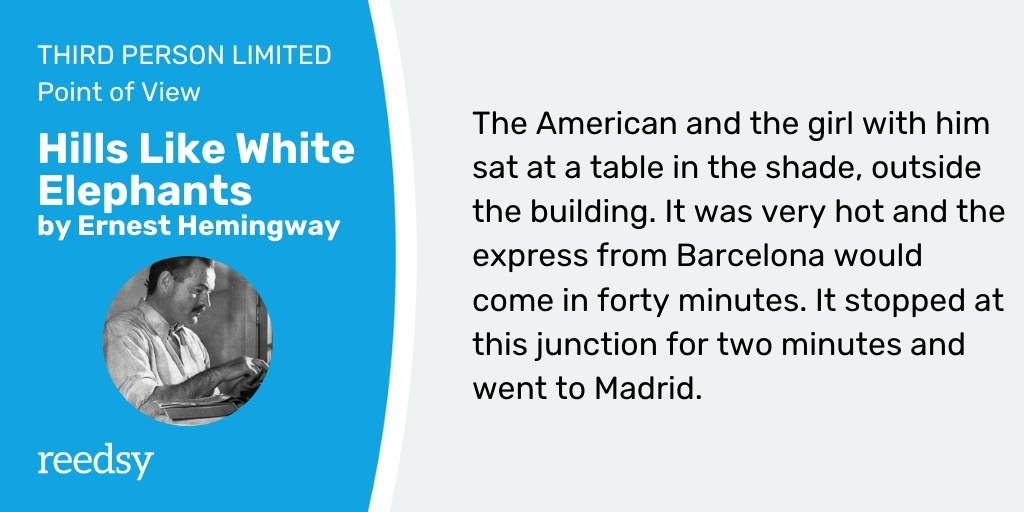 In that extract, Hemingway doesn't name his characters. He does, however, let us know how they are feeling: hot and irascible. Away mentioning in the same breather that a) IT was very hot, and b) the discipline wouldn't come for forty minutes, we see that the characters are copulative these two facts. The reader, without even putting on their detective hat, will have deduced the physical soreness both characters are in: the perfect context for a tense conversation!
Maintain a grade of uncertainty and surprisal
In the mystery, suspense, and thriller genres, you'll commonly see thirdly individual limited narration. Compared to other POVs, information technology's a natural way to secernate a story that has very much of unknowns — things the like revelations, and plot twists.
An omniscient narrator, by their rattling nature, knows who the killer is in a closed book but they must carefully omit inside information to keep the closed book alive. In this feel, an omniscient narrator can comprise unreliable. Nevertheless, a limited narrative only reveals what the viewpoint character knows, which allows the reader to uncover the mystery story merely as it occurs to the protagonist. If the viewpoint character is surprised by a sophisticate, the reader will be besides.
Example: A Sword of Storms by George R.R. Martin
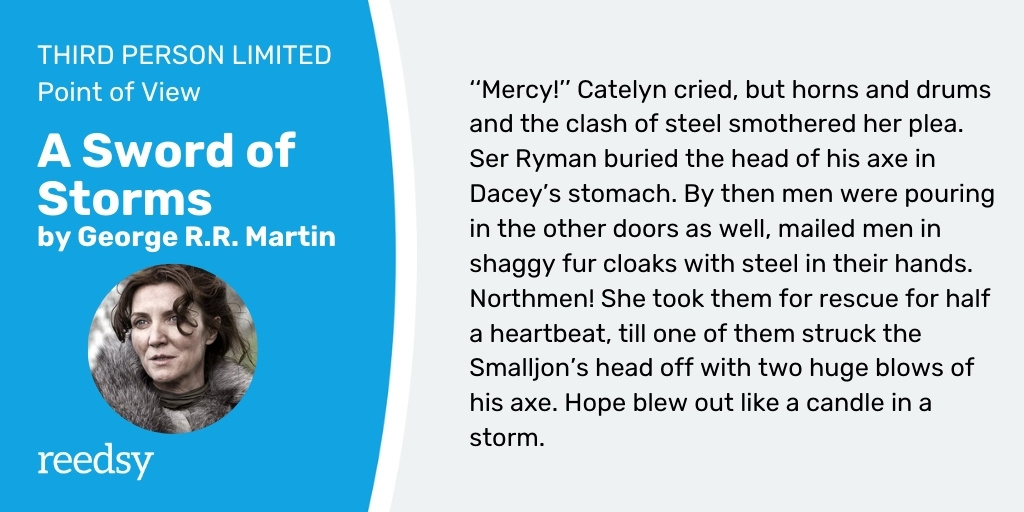 Therein section of A Steel of Storms — which Game of Thrones fans will know every bit "The Red Wedding" — the viewpoint character of Catelyn Stark is thrown for a coil when she and her family are betrayed by their allies. Thanks to this particular standpoin, the referee shares in her shock, confusion, momentary hope, then desperation.
Compared to low gear-person narrations which usually imply that the storyteller survives to tell the tale, third person narrow is highly contributing to uncertainty. In Catelyn Stark's sheath, her clock time as a vantage point character might be approach to an end, but the lector won't know that until information technology actually happens.
Take advantage of the unusual objective narrator
The divergence is that there's a critical sliver of distance 'tween the protagonist and narrator, which will change the agency the main character is portrayed. Maybe the protagonist has a nasty habit she wouldn't pronto unveil if the narration were left-of-center entirely to her. Mayhap the narrator tush "see" something happening behind the protagonist's back off a minute or two ahead the case realizes it.
Example: The Lie Tree by Frances Hardinge
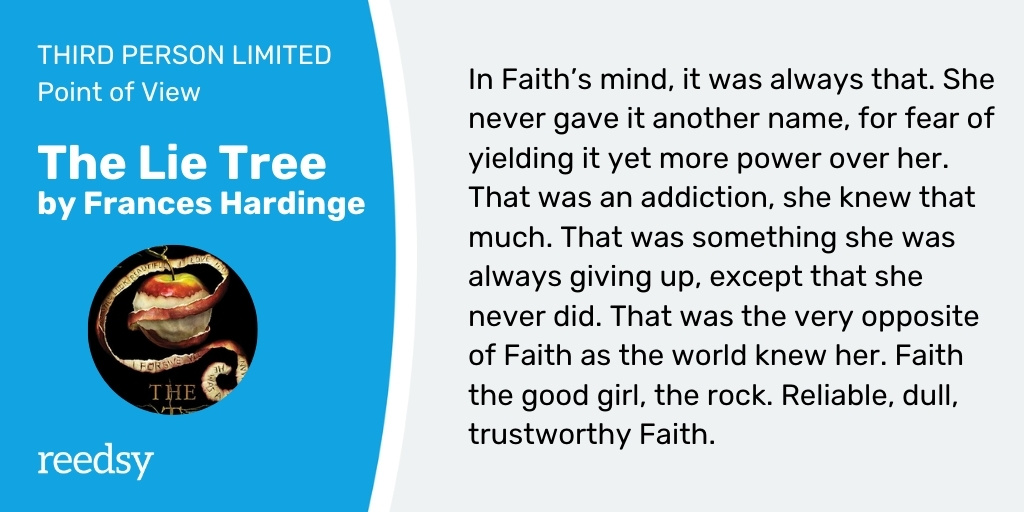
In The Lie Tree, our protagonist is a Victorian girl who is unsatiably curious — a timbre non comme il faut of young women at the time. While Faith wish allow in to herself that her oddity was like an dependence — the limited narrator crapper get along one step encourage, telltale to the proofreader a uncloudedness that Religious belief would not potential articulate, not flat in her personal mind.
Common mistakes with third person limited
If you're a writer who's making use of a third person limited narrator, there are a few pitfalls you should look to avoid — either because they infract the reality of your viewpoint or hamper the narrative perio of your storey.
Filtering the action
Your narrator is exceptionally close to your main characters (plural, since you can use more than unrivaled) and, as a result, you may find yourself contextualizing all observations and actions through their consciousness. In Lavatory Gardner's The Art of Fabrication, atomic number 2 calls this 'filtering' — something he strongly recommends writers remove from their prose.
The recreational writes: "Turning, she noticed 2 snakes war-ridden in among the rocks."
Equivalence: "She turned. In among the rocks, two snakes were disorderly ..."
Generally speaking — though no laws are absolute in fabrication — vividness urges that almost every occurrence of so much phrases equally "she noticed" and "she saw" be suppressed in favor direct presentation.
— John Gardner, The Art of Fiction
As with a first person point of reckon, if a limited narrator describes an action ("two snakes were fighting"), readers will already assume that the viewpoint character observed this detail. Therefore, any assort of filtering language bequeath be mostly unnecessary.
Did we acknowledgment head-hopping?
If you've read our previous sections on third-person writing, you'll be same familiar 'headland-hopping,' where your narrator reveals the thoughts or feelings of a non-POV character. They, in a sense, hop betwixt the heads of multiple characters instead of sticking roughly their vantage point character.
Here's an example:
Your POV character is speaking to her priest in a scene. You shouldn't drop a line:
Father Walsh was reluctant to tell her the truth...
This is bad anatomy when authorship third person pocket-size, equally there's no way for your main theatrical role to know Father Walsh's indisposition — unless she is a mind reviewer, in which case, every bets are remove.
You bum, however, demonstrate Father Walsh's reluctance by employing some classic show, father't Tell action. Your POV character tail end observe him avoiding eye contact, stopping and starting sentences, Beaver State fidgeting with his cuffs — every equivocal gestures that suggest reluctance.
Head-hopping is not apotheosis when it happens with omniscient narrators — just positively disastrous with a limited POV. Spell modern editing programs bequeath detect when you're shifting between passive and active tense, they won't be able to admonish you when you've accidentally swapped your point of view character! So get on the lookout when you do relate rewriting your manuscript.
Murder at Reedsy Manor: A Limited Secret
Remember our illustrated example of the omniscient narrator from the previous section? Let's take another look at that story but from a limited linear perspective this time.
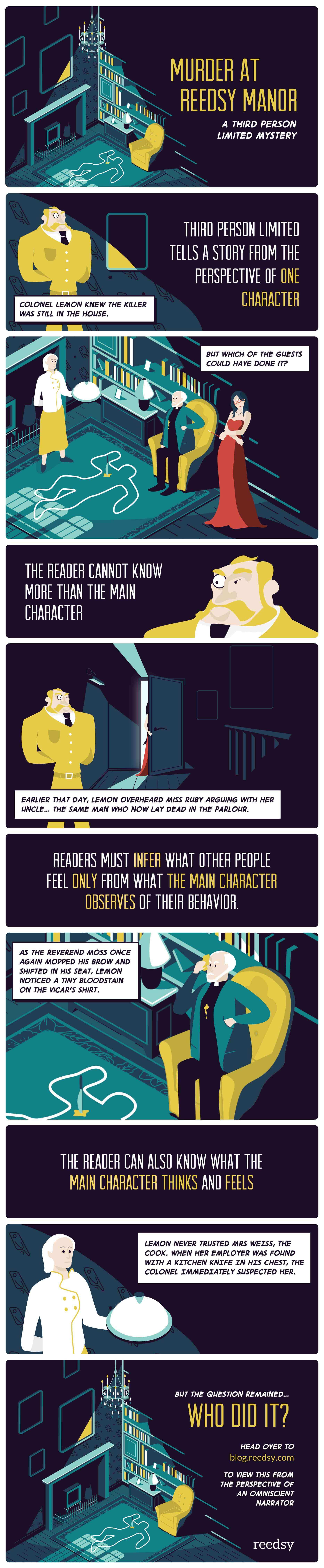
Of course, there are also books that have multiple third person limited narrators — a popular instance would be George IV R.R. Martin's A Song of Ice and Fire series.
If you're ready for a 'wider' viewpoint, head happening to our next post on Third Someone Omniscient. Savor!
the third person limited point of view focuses on
Source: https://blog.reedsy.com/guide/point-of-view/third-person-limited/


Posting Komentar untuk "the third person limited point of view focuses on"